Calculating rotation invariant GLCM textures
This post outlines how to use the glcm package to calculate image textures that are direction invariant (calculated over "all directions"). This feature is available in glcm versions >= 1.0.
Getting started
First install the latest version of glcm, and the raster package that is also needed for this example:
install.packages("glcm")
library(glcm)
library(raster)
Calculating rotationally invariant textures
glcm supports calculating GLCMs using multiple shift values. If multiple shifts are supplied, glcm will calculate each texture statistic using each of the specified shifts, and return the mean value of the texture for each pixel.
In general, I have not found large differences in calculated image textures when comparing GLCM textures calculated using a single shift versus calculating rotationally invariant textures. However this may not be the case for images with strongly directional textures.
To compare for a sample cropped out of a Landsat scene, use the L5TSR_1986 sample image included in the glcm package. This is a section of a 1986 Landsat 5 image preprocessed to surface reflectance from the Volcán Barva TEAM site.
When glcm is run without specifying a shift, the default shift (1, 1) is used (90 degrees), with a window size of 3 pixels x 3 pixels:
test_rast <- raster(L5TSR_1986, layer=1)
tex_shift1 <- glcm(test_rast)
plot(tex_shift1)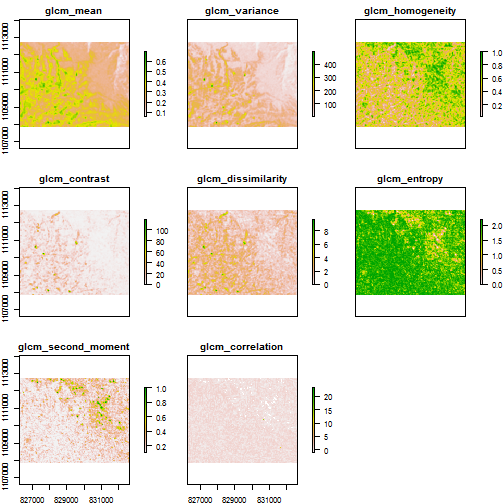
To calculate rotationally invariant GLCM textures (over "all directions" in the terminology of commonly used remote sensing software), use: shift=list(c(0,1), c(1,1), c(1,0), c(1,-1)). This will calculate the average GLCM texture using shifts of 0 degrees, 45 degrees, 90 degrees, and 135 degrees:
tex_all_dir <- glcm(test_rast, shift=list(c(0,1), c(1,1), c(1,0), c(1,-1)))
plot(tex_all_dir)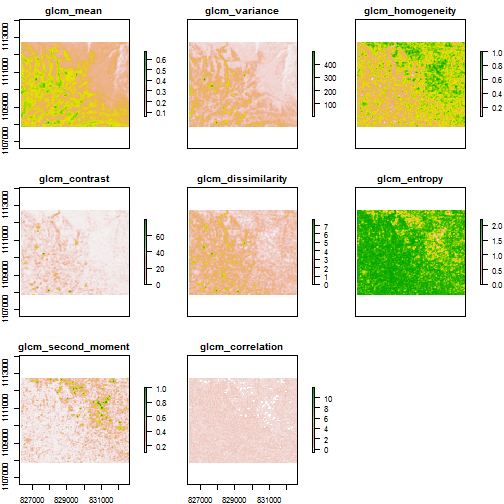
To compare the difference between these textures, subtract the textures calculated with a 90 degree shift from those calculated using multiple shifts, and plot the result:
plot((tex_all_dir - tex_shift1) / tex_all_dir)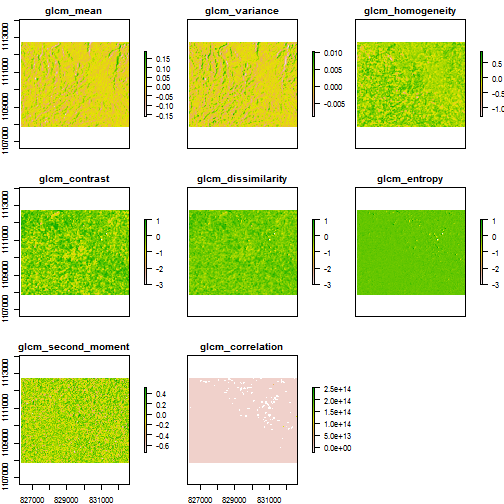
Computation time
There is a performance penalty for using a rotationally invariant GLCM (not surprisingly, as more calculations are involved). Using microbenchmark to compare:
library(microbenchmark)

glcm_one_dir <- function(x) {
  glcm(x)
}

glcm_all_dir <- function(x) {
  glcm(x, shift=list(c(0,1), c(1,1), c(1,0), c(1,-1)))
}

microbenchmark(glcm_one_dir(test_rast), glcm_all_dir(test_rast), times=5)
The rotationally invariant calculation takes roughly 4x longer, which is expected since we're computing textures for four directions instead of one.
Learn More
The full documentation for the glcm package is available on CRAN.